
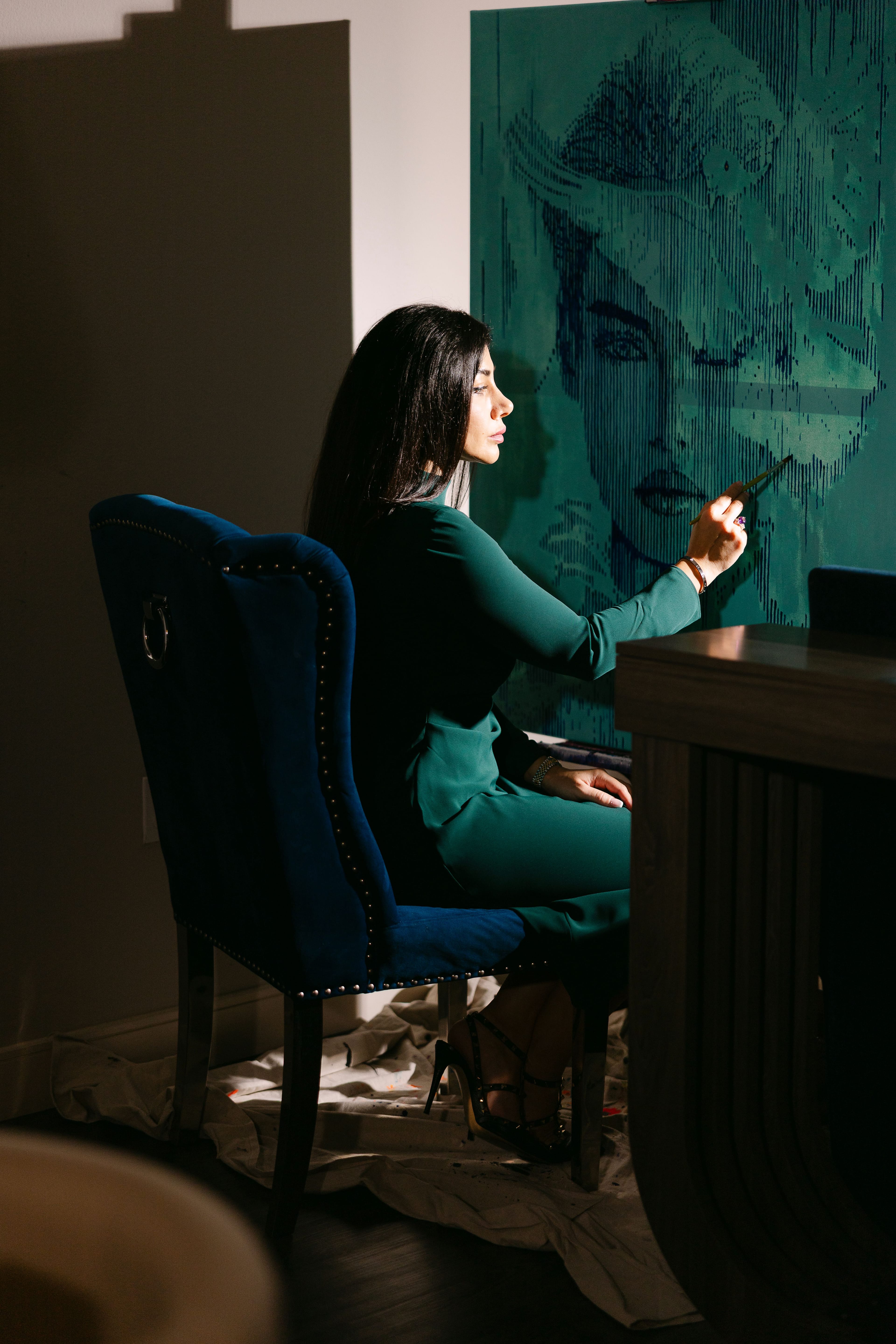
Inside the Studio: How a Vertical Line Portrait Is Made
A finished vertical line portrait can look inevitable — a face rising cleanly out of a field of lines. In the studio, it is anything but. Each piece is built slowly, one hand-drawn line at a time, from a plan you would never guess from the final work. Here is how a vertical line portrait actually comes together in the studio of contemporary artist Bita Zola — from a blank canvas to a signed, one-of-a-kind original.
It starts with light, not lines
Before a single line is drawn, the subject is studied as a map of light and shadow. The face is broken down not into eyes, nose, and mouth, but into zones of brightness and darkness. This tonal map is the true blueprint of a vertical line portrait: the lines that follow are simply a way of translating those values into rhythm.
Drawing the lines — the slow part
With the tonal map in mind, the drawing begins. Every line runs vertically, top to bottom, and tone is created by nothing more than how close together the lines sit. Dark areas are dense; highlights are open and spare. There is no shading to hide behind and no outline to lean on, so concentration matters — a single wandering line can flatten an entire passage. A large portrait can hold thousands of lines and take many focused hours to resolve.
- Spacing sets the tone — tight for shadow, open for light.
- Pressure and weight shape depth, modeling a cheekbone or jaw without a contour.
- Rhythm keeps the surface alive, so the work reads as movement rather than pattern.
Working at scale
Many of Bita Zola's portraits are made on large framed canvases, and scale is part of the point. A big surface gives the lines room to breathe and makes the finished work physically immersive. It also makes the technique less forgiving — the bigger the canvas, the more discipline each line demands.
Engineering the Distance Effect
Throughout the process, the artist steps back across the studio again and again. Up close the surface looks abstract; from a distance the face appears. This is the Distance Effect, and it is not a happy accident — it is checked and adjusted at every stage, tuning line density until the portrait resolves at exactly the right viewing distance.
Knowing when a portrait is finished
Perhaps the hardest part is stopping. Add too few lines and the face never fully arrives; add too many and the light drains away. A vertical line portrait is finished when the tonal map is complete and the image holds together from across the room — no sooner. Only then is it signed and released as a one-of-a-kind original.
See the work
You can explore finished originals such as Between Two Selves in the gallery, learn more about Bita Zola, or read our introduction to vertical line portraits if you are new to the style. To ask about a specific piece, simply get in touch.