From Persian Miniatures to Vertical Lines: How Heritage Shapes Contemporary Iranian Portraiture
Long before the camera or the oil portrait reached Persia, the line did the work of both. In Persian miniature painting, in the sweep of calligraphy, in the geometry of tilework and carpets, it was line — not shadow — that carried beauty, movement, and meaning. That inheritance never disappeared. Today a generation of contemporary Iranian artists is carrying the line forward in new forms, among them Bita Zola, whose vertical line portraits translate a centuries-old sensibility into a strikingly modern language.
This is the story of how Persian heritage shapes contemporary Iranian portraiture — and why the line, of all things, keeps returning.
The line as the soul of Persian art
Western painting spent centuries chasing the illusion of three-dimensional flesh: chiaroscuro, sfumato, the modeled shadow. Persian visual art took a different path. In the miniature tradition, form is described through contour, pattern, and color laid down in clear, deliberate lines. Calligraphy — among the most revered of the Persian arts — elevates the line itself to the highest expression of the spirit, where the movement of the pen is the meaning. Across manuscripts, ceramics, and architecture, the Persian eye was trained to find depth and emotion not in shadow, but in rhythm.
Portraiture, the Persian way
Persian art has always approached the human figure with a poet's eye rather than an anatomist's. Instead of reproducing a face exactly, the tradition sought to distill presence, mood, and inner life — essence over likeness. Even in the more figurative portraiture of the Qajar era, stylization, ornament, and line remained central. The result is a way of picturing people that lives comfortably between representation and abstraction — a balance that feels remarkably contemporary today.
Identity and duality in the Iranian diaspora
For Iranian artists living between cultures, that in-between quality has become a subject in its own right. Themes of memory, exile, belonging, and the divided self run through much of contemporary Iranian and diaspora art. Curatorial platforms devoted to this work — among them New York's Roya Khadjavi Projects, which has presented dozens of exhibitions of emerging and diaspora Iranian artists over the past decade — have helped carry these voices to international audiences. The through-line is identity: what we show, what we conceal, and how the two coexist.
Bita Zola: heritage reimagined in vertical lines
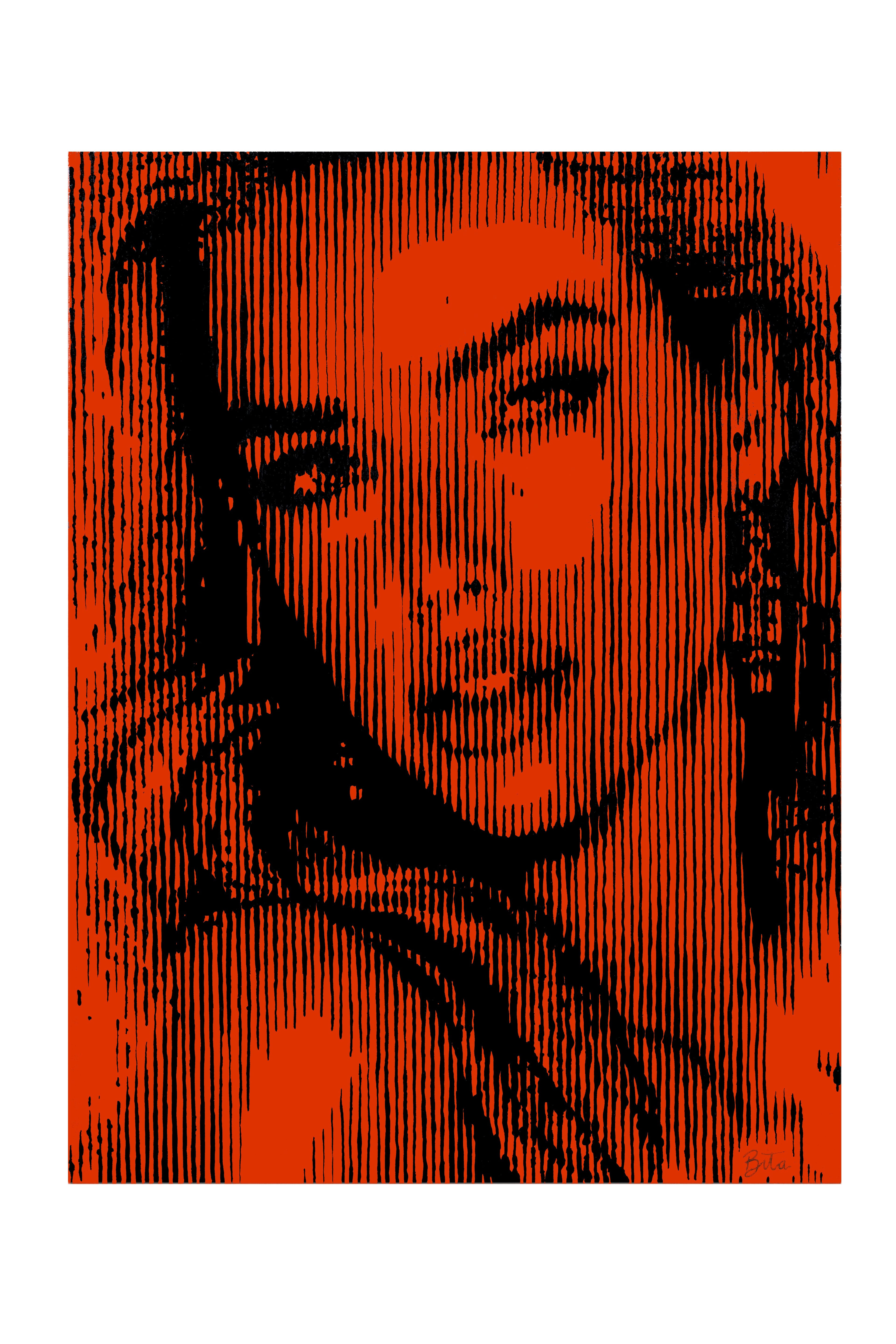
It is precisely this territory that Bita Zola works in. Her vertical line portraits build a human face entirely from fine, closely spaced vertical lines — no shading, no outline, only the density and rhythm of the mark. The lineage is unmistakable: the same faith in line over shadow that defines the Persian tradition, carried into an abstract-realist idiom.
Her technique also gives the old themes a new body. In works such as Between Two Selves, one face emerges in clarity while another dissolves into shadow — the seen self and the unseen self held in a single frame. Step back, and the portrait resolves; move closer, and it breaks into pure abstraction. This Distance Effect is more than a visual trick; it is a metaphor for the layered, shifting nature of identity that so much diaspora art explores.
A living tradition
What makes this moment exciting is that the Persian line is not being preserved under glass — it is being reinvented. A widening circle of contemporary Iranian artists, curators, galleries, and collectors is redefining what Persian identity looks like now, and portraiture built on line sits at the heart of it. Bita Zola's work belongs to that conversation: rooted in a heritage that has always trusted the line, and reaching toward something entirely of the present.
To explore the work, browse the gallery, read more about Bita Zola, or get in touch about a specific piece.