
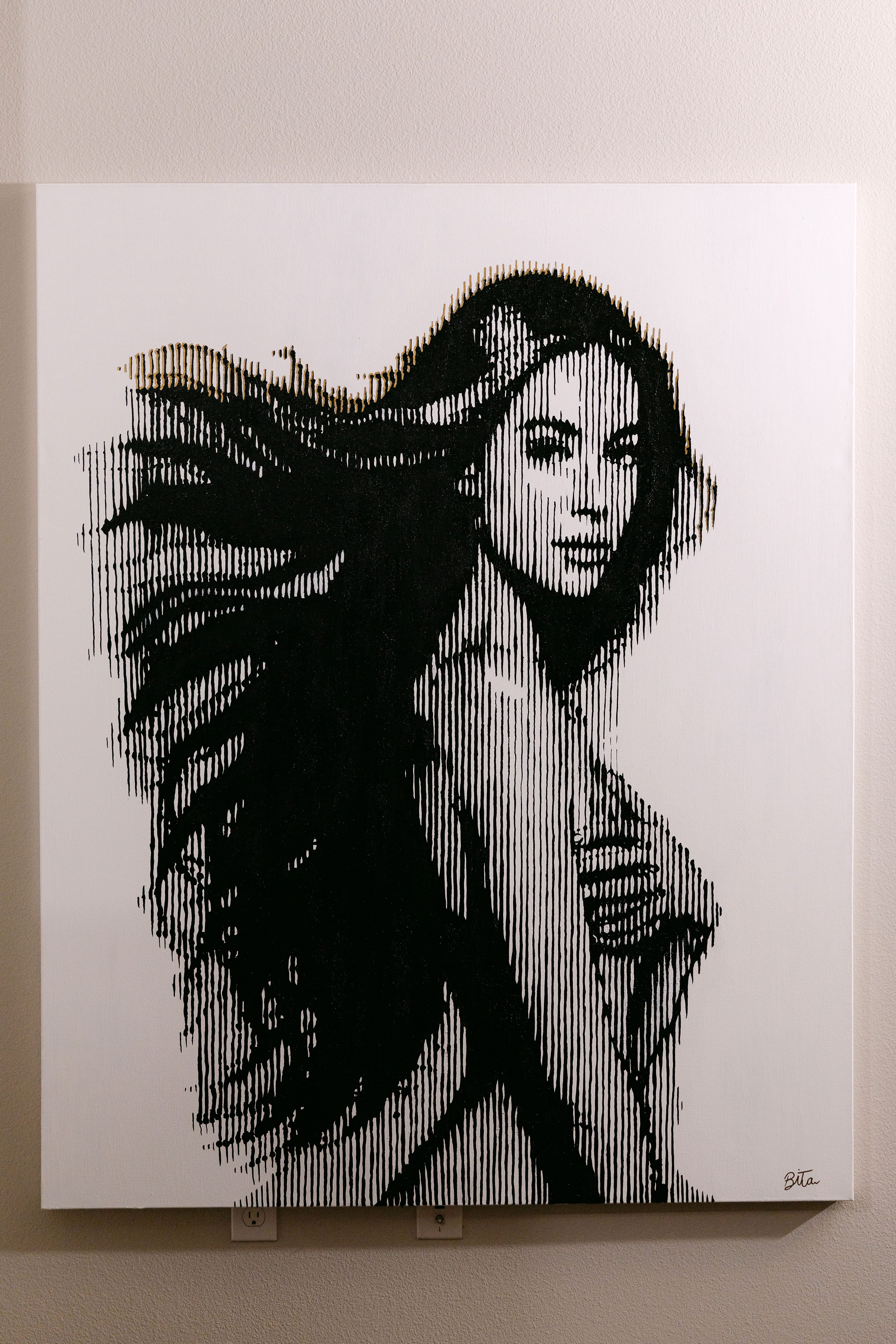
A Collector's Guide to Contemporary Vertical Line Portraits
Over the past decade, the vertical line portrait has become one of the most quietly arresting forms in contemporary drawing. Built not from shading or color but from hundreds of fine, closely spaced vertical lines, these portraits ask the viewer to do something unusual: to step back, to look slowly, and to watch a human face assemble itself out of pure rhythm. Few artists have shaped this language as deliberately as Bita Zola, whose contemporary line portraits have drawn a growing audience of collectors across the United States and abroad.
If you are considering acquiring your first line portrait — or adding one to an established collection — this guide covers what these works are, why they hold their value, and how to buy, frame, and care for them with confidence.
What is a vertical line portrait?
A vertical line portrait is a work in which the entire image — the planes of a face, the fall of light, the depth of a gaze — is described through vertical lines alone. Where a traditional drawing relies on smudged tone or cross-hatching, a contemporary line art portrait creates form through density: lines drawn close together read as shadow, lines drawn apart read as light. The result sits between abstraction and realism, a quality often described as abstract realism.
In Bita Zola's work, this technique produces what she calls the Distance Effect. Viewed up close, the surface dissolves into an almost musical field of marks; seen from across a room, the same lines resolve into an unmistakable, emotionally present face. A single vertical line portrait therefore behaves like two works in one, rewarding both the intimate look and the long view.
Why collectors are drawn to line portraiture
Several qualities make the contemporary line portrait especially collectible:
- Restraint and modernity. The reduced palette and clean geometry sit naturally in contemporary and minimalist interiors, without competing with a room.
- Emotional resonance. Because the eye completes the image, viewers report an unusually personal connection to the work — it feels discovered rather than delivered.
- Genuine scarcity. True specialists in vertical line portraiture remain rare. Collecting within a small, well-defined field is one of the more reliable ways to acquire work with a clear artistic identity.
Originals versus fine-art prints
Most collectors acquire a line portrait in one of two forms, and understanding the difference is the single most useful thing to know before you buy.
Original works
An original is a one-of-a-kind drawing, executed by hand in ink or a comparable archival medium on paper or panel. Originals carry the full presence of the artist's hand — the subtle pressure changes, the living irregularity of each line — and they sit at the top of the market in both significance and value. For collectors focused on long-term cultural and financial worth, an original line art portrait is the definitive acquisition.
Limited-edition fine-art prints
A fine-art print is a museum-grade reproduction — typically a pigment (giclée) print on archival cotton paper — produced in a strictly limited, numbered edition and signed by the artist. Prints make an artist's work accessible at a more approachable entry point while preserving collectible integrity through edition limits. A signed, numbered edition of, say, 25 behaves very differently from an open, unlimited poster; the smaller and better documented the edition, the stronger its standing.
How to evaluate a line portrait before you buy
Whether you are looking at an original or an edition, a few checks separate a considered purchase from an impulse one:
- Provenance and documentation. Insist on a certificate of authenticity recording the title, year, medium, dimensions, and — for prints — the edition number. This paperwork is what protects resale value.
- Materials. Archival inks and acid-free substrates are essential; they are the difference between a work that ages gracefully and one that yellows.
- Edition size. For prints, smaller editions with clear numbering hold value best.
- The artist's trajectory. Exhibition history, press, and a consistent body of work all signal an artist whose market is likely to deepen over time.
Living with the work: framing, placement, and care
A line portrait is a work on paper, and it rewards a little stewardship:
- Framing. Use an acid-free mat, museum-grade UV-filtering glazing, and ideally a float mount that lets the paper's edges show. Good framing protects the work and honors its minimalism.
- Placement and light. Hang away from direct sunlight and sources of humidity. Even, indirect light preserves both the paper and the crispness of the line.
- Handling. Handle by the edges or with cotton gloves, and store flat or framed rather than rolled.
Because the Distance Effect depends on viewing range, give the work room to breathe — a wall you can step back from will always show a vertical line portrait at its best.
Starting or growing your collection with Bita Zola
Bita Zola works from her studio in Irvine, California, and places work with private collectors across the United States and internationally. Her available original portraits and limited-edition prints are catalogued in the gallery, and each acquisition arrives with full documentation. Collectors early in their journey often begin with a signed edition and later commit to an original as their eye and collection mature.
To learn more about the practice behind the work, read about Bita Zola, explore the current collection, or enquire about available works. A considered vertical line portrait is not simply a picture on a wall — it is a quiet, enduring conversation between the artist's hand and your own attention.